
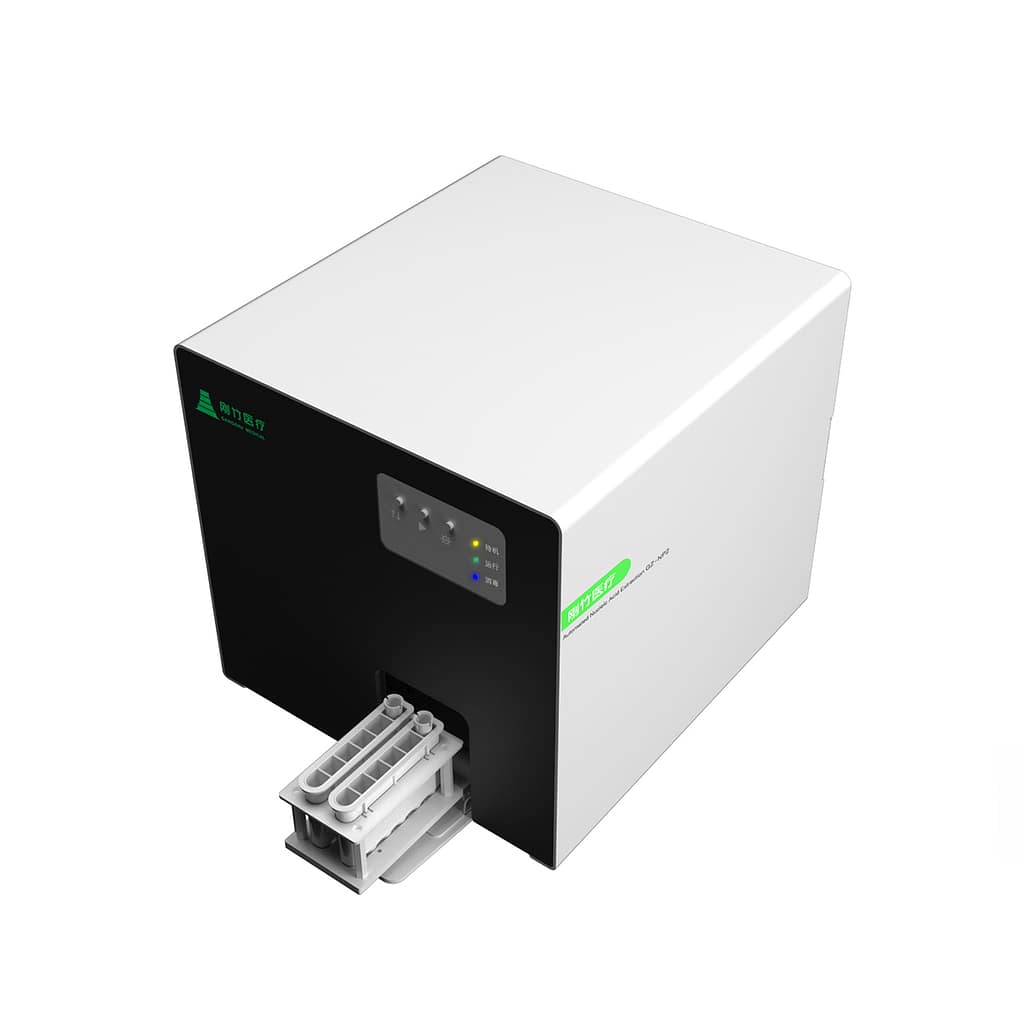
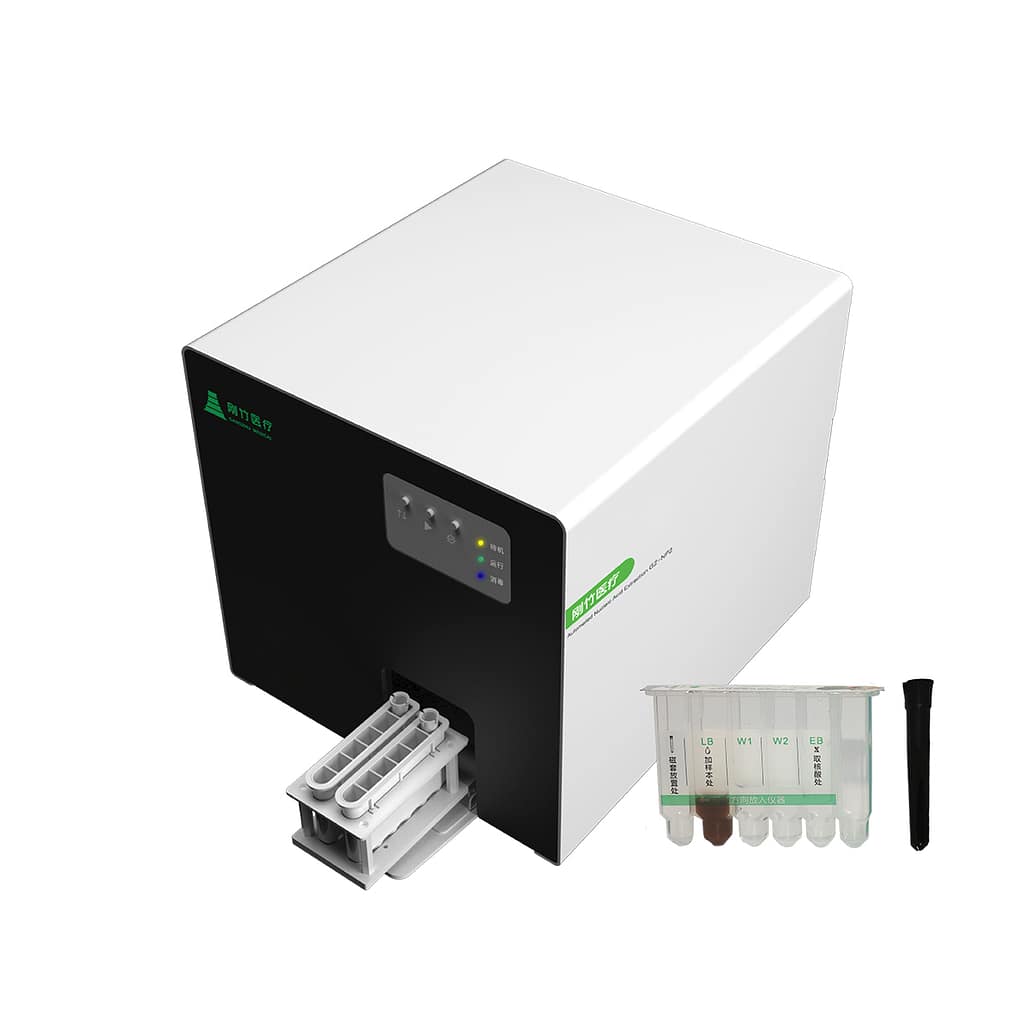
GZ-NP2 核酸自动提取仪
宠物临床样本自动化核酸提取解决方案
| Working principle | Magnetic bar method |
| Sample volume | 100-1000uL |
| Number of bar magnets | Two |
| Sample throughput | Two |
| Magnetic bead recovery | 95% |
| Sensitivity | 1000 copies/mi |
| Difference between holes | CV5% |
| Single run time | 8 minutes/time |
| Consumables | Dedicated pre-set consumables for single throughput |
| Pollution control | UV disinfection |
| Shake and mix | Fixed frequency 3HZ |
| Operation interface | Physical buttons |
| Program management | Built-in fixed templa |
| Equipment net weight | 3.7Kg |
| Working environment | 0-40℃,<80%RH |
| Mains power | Built-in power supply AC 110-250V 70W |
| Dimensions | 226mm*207mm*205mm |
Step 1: Take out an extraction reagent kit, tear off the top seal of the kit, then take a magnetic rod sleeve and place it in the corresponding well.
Step 2: Add 200uL of the prepared sample into the LB well. (Fig 1)
Step 3: Place the extraction reagent kit into the automatic extractor, then press the “Run” button to start the nucleic acid extraction. (Fig 2)
Step 4: After completing the nucleic acid extraction, take 20uL purified nucleic acid from the EB well and add it to the PChreagent tube, flick the reagent tube with fingers or use a vortex oscillator to shake and mix the lyophilized reagentcompletely. (Fig 3)
Canine & Feline Pathogens
Concurrent Illnesses in Humans and Pets
Exotic Animal Pathogens
Animal health Genetic test: Tumor, Kidney disease, Blood Type(developing)
Consumer-Grade Genetic Testing for Pets(developing)